Your Kitchen Might Be Stressing You Out Before You Even Make Coffee
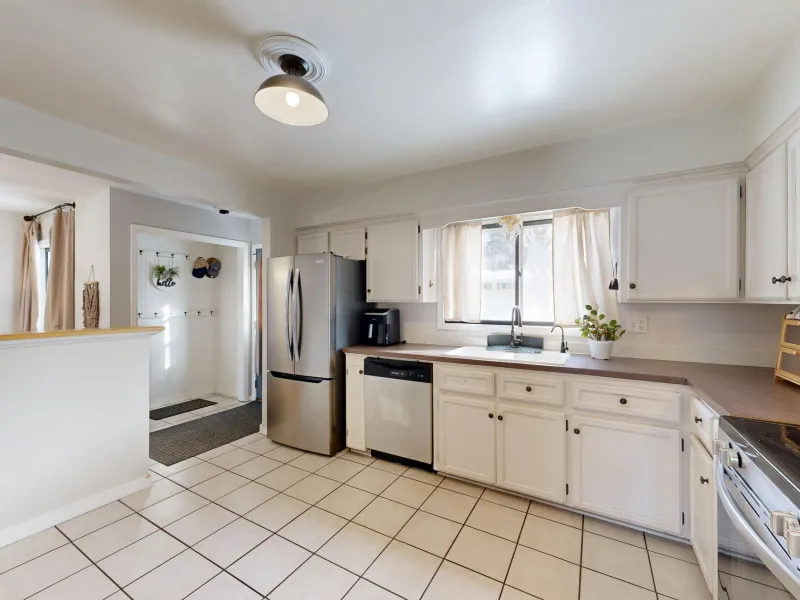
You haven't said a word to anyone yet. You haven't opened your email. And somehow, you're already tense.
There's a decent chance the culprit is standing right in front of you — or rather, surrounding you. Your kitchen.
We tend to think of mood as something that happens to us: traffic, deadlines, a tense text exchange. But environmental psychologists — the researchers who study how physical spaces shape our inner states — have been making a quieter case for years. The rooms we move through first thing in the morning and last thing at night have a measurable effect on our stress levels. And the kitchen, for most American households, is the highest-traffic room in the house.
If yours is dim, cluttered, and chaotic, it may be working against you before you've even made coffee.
The Kitchen-Mood Connection Is Real
Here's the short version of the science: cluttered, visually noisy environments are associated with elevated cortisol, the body's primary stress hormone. A well-known 2010 UCLA study on family life found that mothers who described their homes as cluttered showed higher stress hormone patterns throughout the day than those who didn't.
Then there's the lighting problem. Harsh overhead fluorescents — a staple of American kitchens built in the last few decades — can feel institutional at 6 a.m. and jarring at 10 p.m. Poor lighting disrupts circadian rhythm cues, which ripple outward into sleep quality, appetite regulation, and mood.
And finally, the layout. If your counters are buried, your trash can requires a scavenger hunt, and your coffee setup lives in three different places, every kitchen task becomes a series of tiny frictions. Individually, they're nothing. Stacked together, day after day, they add up to a low-grade hum of irritation — and research on decision fatigue suggests those small frictions make us more likely to reach for the easiest comfort available, which is often food.
Stress eating isn't a willpower failure. Sometimes it's a design failure.
The 15-Minute Kitchen Audit
You don't need a renovation. You need a walkthrough. Grab your phone, set a timer, and move through your kitchen asking these questions:
Minutes 1–5: Look at the light.
- Is your only lighting a bright overhead fixture? That's a red flag.
- Can you see clearly at the counter where you prep food?
- Is there any warm, low-level light for evening use?
Minutes 5–10: Read the counters.
- How much of your counter space is visible? If it's under half, clutter is likely registering as visual noise every time you walk in.
- Are the items out on display things you actually use daily — or just things that never got put away?
- Is there a "junk zone" — one counter or table that accumulates mail, keys, and everything else?
Minutes 10–15: Trace your routines.
- Walk through making coffee, getting a glass of water, and taking out the trash. Count the extra steps and annoyances.
- Notice anything that makes you sigh. That sigh is data.
The Fixes: Fast, Cheap, and Genuinely Effective
Swap one lightbulb. Replace the overhead bulb with a warmer temperature (around 2700K) for evenings. Cost: a few dollars. Effect: your 9 p.m. kitchen stops feeling like a gas station.
Add one task light. A plug-in under-cabinet or counter lamp at your prep area costs under $25 and does more for a kitchen than most decor ever will.
Clear one counter completely. Not all of them. One. Pick the one you see when you walk in, remove everything that doesn't get used daily, and defend it. Visible clear space reads to your brain as calm.
Create a landing zone. If mail and keys colonize your counters, give them a single home — a basket by the door, a wall hook. Chaos needs a designated container.
Fix the friction points. Move the trash can closer to the prep area. Consolidate the coffee supplies. Put the water glasses within reach of the sink. Each fix takes two minutes; each one removes a daily annoyance you've stopped noticing but your nervous system hasn't.
Consider the sound. A silent kitchen amplifies whatever's in your head. Some people thrive on a morning playlist; others find that a few minutes of slow humming while the coffee brews — a practice we've covered before — settles the nervous system better than any podcast. Your kitchen acoustics are part of the room's mood, whether you've thought about them or not.
A Kitchen That Works With You, Not Against You
None of this is about having a magazine-worthy kitchen. Some of the most soothing kitchens we've seen are small, dated, and imperfect — but well-lit, mostly clear, and easy to move through.
The point is alignment: a space whose design matches the life you want to live in it. If you want to cook more, stress less, and stop wandering into the fridge at 11 p.m. out of pure depletion, your environment can either be an ally or an obstacle.
Start with 15 minutes and one warm lightbulb. Your morning self will thank you — even before the coffee.